Monday, September 17, 2012

Rosh Hashana morning 5773


 Rosh Hashana Morning 5773
Avinu Malkeinu: a deeper meaning
Temple Beth Jacob of Newburgh
Rabbi Larry Freedman


There are always so many ideas, so many things to talk about for our High Holiday sermons.  When I was new at this I panicked that I wouldn’t have any idea what to speak on.  Now I find ideas throughout the year and jot them down.  I still have to compose the thing but at least I don’t panic.


This past year, however, I kept getting called back to the basics.  Over the year, as I spoke with people and taught various classes, it seemed that while everybody is confident in being Jewish, not everyone is confident in depth of knowledge.  It’s as though we all have a little shmear of Judaism in our lives.  It adds some flavor but we only know the surface.  We’re eating the cream cheese.  We’ve got no bagel.  So this year, I want to give you a bagel.  But not just any bagel.  Not those fluffy 500 calories offenses found in a supermarkets or  -shudder- Pepperidge Farm.  I’m talking about a bagel bagel.    The dough is allowed to ferment overnight, it’s boiled and then baked, it’s reasonable in size, it is almost crusty on the outside and soft on the inside and it tastes like Hester Street.  Frankly, so few of us have had a proper bagel we hardly would know it if we found one.  But a real bagel is rich and engaging with a bit of tang and something that can carry you through the day.  It connects you to your heritage and it transports you for a moment as you crunch through the top and enter into the mysteries of the center.

Shall I push this metaphor further?  No?  So let’s get on with it.  Let me offer you a real Jewish bagel and let me call it Avinu Malkeinu.

Avinu Malkeinu is a highlight of the High Holidays.  It would hardly seem like Rosh Hashana if we didn’t sing it.  The melody is anticipated and the waltz rhythm is comforting.  That’s the shmear.  But what do the words mean?  What is this poem saying?

We start with Avinu Malkeinu.  Our father, our king.  It starts with an intentional contrast of image.  We think of God as father.  Stern, perhaps, but loving. A father wants to see you succeed. Of course, our father-avinu- also tends to be more amenable when we behave better.  Our Father is always more giving and forgiving to God’s children when we are nice, when we are kind, when we do what we should do.  Be immature, act cruelly, flout reasonable rules and God has to punish.  I will be disinclined to do what YOU want, says God, when you show no interest in doing what I need.

Our king.  A king is something different.  A king can be concerned but aloof.  A king must worry about the needs of all the people, not just one.  A king must be strong and, at times, severe.  A king holds power and we must carefully and respectfully appeal to that power and hope. Total authority.  And if you do right then malkeinu will do right by you even beyond customary kingly protection.

What do we do when we appeal to our father, our king?  We engage all of these attitudes at once:  indulgent and aloof; worried about you and worried about everyone else.  Who will respond when we sing avinu malkeinu.  Will it be daddy who’s arms we run into?  Will it be the king who is busy with other things?  It is a crazy, scary moment filled with uncertainty.  Avinu malkeinu, hear our voice?  That’s a simple thing for a father to do but a king?  Avinu malkeinu we have sinned before you.  A father might -with love- forgive but are you sure you want to admit sin to a king?  Avinu malkeinu, make an end to sickness, war and famine.  Such a demand we make!  A father can comfort us when these things happen but a king has the power to decree change and we demand from our king to do so!

As you read Avinu Malkeinu, think of a father figure.  Imagine a king.  How would each respond to our petition? Think of a time you asked for something from your father.  How did that feel?  Think of a time you asked for something or even demanded something from someone who held power over you.  How did that feel?  Tap in to those feelings.  Remember those feelings and bring them to Avinu Malkeinu.  Put yourself in the imagery, sing it as if you really were in front of your father or your king.  It is a scary, loving, bold, submissive poem.  It is awash in emotion and contrasting feelings.  If you can truly give yourself over to the imagery, that will be quite a moment.

And what of changing the gender?  Having gender neutral God language is a major issue in Reform Judaism and a serious theological effort.  The reason for this is that by assigning God a gender we limit our imaginations of what God can be.  If we can remove gender from God then we open our minds to a myriad of other ideas about what God is.  We allow for more sophistication.  That’s why referring to God as a “she” is no more helpful than he and “he or she” is just silly and “it” also limits us.

Most of the time, most anywhere, I am careful about my gender neutrality.  I don’t want my ability to ponder God to be sidelined by grammar.  But here, on Rosh Hashana and Yom Kippur, I do engage in imagery so powerful that to change it does injustice to the effect of the prayer.  In this case, an attempt to free my mind by changing the words would do serious damage to a larger theological point found in the specific poetic word choices.  To paraphrase a beer commercial, I don’t always think of God in male terms, but when I do, I do so with Avinu Malkeinu.

Avinu Malkeinu in its original form has 44 verses.  We tend to read nine or ten at a time.  We’ve removed the section where we demand God say yes to our prayers for the sake of our martyrs.  We’ve removed the line where we ask avinu malkeinu to take revenge on our enemies.  Clearly this prayer was developed during a rough period in our history.  We’ve taken out the parts that are close to repetitious. We’ve also taken out the more agrarian requests like asking for our storehouses to be filled and fill our hands with blessing with good crops and such.  Even with these edits, the repetitious plea after plea after plea, the grinding groveling, we understand the level to which we have lowered ourselves before our father, our king.

Where did it come from, this wildly popular poem?  It’s origin is found in the Talmud,[1] in a discussion about fast days in case of drought. 
Here’s the Talmud text. 
"Rabbi Eliezer once went before the ark [to conduct the service on a public fast day] and recited twenty-four blessings [of the prayer for rain] and was not answered. Rabbi Akiva went [before the ark] after him and said, 'Our Father, our King - we have no king other than You! Our Father, our King - for Your sake have compassion for us!' It then started raining.
"The rabbis started speaking unfavorably [about Rabbi Eliezer]. A Heavenly voice emerged and declared, 'Not because this one [Rabbi Akiva] is greater than this one [Rabbi Eliezer], but because this one ma’avir midotav and this one does not ma’avir midotav.'" (Ta'anit 25b)

Rabbi Eliezer and Rabbi Akiva offer dueling blessings to get God to give rain.  Eliezer is ignored.  Akiva’s prayers cause the rain.  The people naturally think Eliezer doesn’t have the stuff and they start talking him down but God’s voice corrects them.  It’s not that Rabbi Eliezer is bad.  It’s just that Rabbi Akiva is so good and what makes him good is that he ma’avir midotav.  And what does that mean?  It’s translated as having “forbearance” or “being humble” but it means more.

Ma’avir means to pass as in take a pass on, skip over.  A midah is a measure, a quantity, characteristic, a dimension, an attribute.  What did Akiva do that was so great?  He skipped over a characteristic, an attribute he has.  And what was that attribute?  It seems that Eliezer was very strict in his understand of Jewish law.  He demanded strict compliance.  Akiva was more easy going.  He was humble in that he didn’t assume he was absolutely, positively correct and that humility allowed him to be reasonable in his rulings.  He had forbearance in that he could tolerate things done right if just less strict.  Of course, Akiva knew how to be strict.  Maybe he even wanted to be strict.  Maybe he wanted to run around and yell at people and be full of himself and throw his weight around.  He was the great Akiva after all.  Maybe deep down inside, Akiva was an egomaniac.  But he passed on that characteristic.  He let it go.

Sometimes someone does something to you and you just want to answer with a sharp retort, you want to attack back.  Maybe you have an attribute that really is a part of you but it’s not the best attribute.  Having negative qualities isn’t a sin.  It’s acting on them that gets you in trouble.  But if you can ma’avir al midotav, if you can let it go, fail to indulge the negative, take a pass on responding with mean-spiritedness, that makes you a great person.  That makes you worthy of being emulated.

Avinu Malkeinu evolved from a story about a rabbi who was listened to because he was able to tamp down his less than stellar ways.  Rosh Hashana is a day not to ask God to forgive you just because.  Rosh Hashana is a day to start asking God to forgive you because you can show that you are taking a pass on the poorer characteristics you, me, we all have.  You know what you do that isn’t good.  You know when passion gets the better of you.  You know when you lose it.  If you can get a handle on that, if you can take a pass on it and choose a better way, that is something God pays attention to.  It’s not about being perfect.  It’s about working on being better than you were last year.  Turn the negative into a positive.

But wait there’s more.  The Chasidic rabbis amplified this attitude with their own story on the story.
A story is told of a certain chasid who each year would give his rebbe a portion of his income, and each year his business prospered. Once he came to see the rebbe and found that he had left. He heard that the rebbe had gone to meet with his own mentor, the Chozeh of Lublin. The chasid was startled to hear that his rebbe has his own rebbe. He therefore decided that rather than giving a portion of his earnings to his rebbe, the Chozeh's student, he would transfer the funds directly to the Chozeh himself. After all, as his rebbe's rebbe, wasn't the Chozeh more worthy?

From that point on, the chasid's earnings began to dwindle as his business deteriorated. He went to the Chozeh of Lublin and asked why this happened, to which the Chozeh responded, "So long as you weren't so fussy about whom you donated the money to, God wasn't so fussy about whether or not you deserved your earnings. The moment you started carefully considering to whom you would prefer to give, then the Almighty likewise began carefully examining if there are others more deserving of the money than you."[2]

An amazing story because, OMG, it’s a story by chasids that suggests a Jew shouldn’t be too uptight about things --- but that’s a different sermon.

For our purposes, the story teaches this:  Avinu Malkeinu, we ask for this and this and this and this.  Please, understand that we aren’t perfect, we make mistakes.  Can’t You just give us a little slack?  And God is saying, my children, my subjects, you are rude and uptight and strict and intense with your own friends and family.  You are so short tempered with other human beings just like you!  You know how hard it is to be perfect and yet tear down your fellow human beings at any chance when they don’t live up to a standard you yourself can’t attain.  You gossip and judge people just like you.  I’ll tell you what, God says, you start going easy on your own friends and family, and I’ll start to go easy on you.  You judge less harshly with them, I will judge less harshly with you.  Avinu Malkeinu can be a chance to show God how we have taken a pass on the less flattering characteristics we all have. It is a chance to say:  See how I have lightened up with those I care for? See how I don’t judge as much?  See how I am turning crabbiness into niceness, turning a short temper into patience, turning the bad into the good?  So you, God, please do the same for us.  Accept our prayers, forgive us.  Follow our lead, God.  As we don’t judge, please You don’t judge.  Avinu Malkeinu, our father, our king, we are learning to be good.  Won’t you be good in return?  One prayer.  Three approaches.  That’s some bagel. A As we add the melodic shmear, we’ll ponder the complexity of going before our father or a king.  We’ll acknowledge our participation in the list of sins and work to remove them from our selves by next year and we implore God to go easy on us since we are trying so hard.  A good and thoughtful new year to us all.


[1] tractate Ta’anit

Erev Rosh Hashana 5773


Rosh Hashana evening 5773

Why are we here?
Temple Beth Jacob of Newburgh
Rabbi Larry Freedman


Shana tova u’metukah.  A good and sweet new year to you all.  You look good.  All dressed up, ready for a new year.  It’s nice to be back in this room.  It’s like visiting an old friend. I’m glad we are here though I look forward to being completely over there at 290 North Street as soon as possible.  We are planning a fun afternoon in the sukkah in a couple of weeks to give you all the best and latest update of the progress of our joint campus.  I hope to see you then, October 7th at 11:30 AM.
But until we gather there, I want to ask why did we gather here?

What are we doing here?  Why do we all come together like this every year?  We enter into prayer to a God we barely address the rest of the year.  We enter into very complex liturgy whose words span centuries carrying the hopes and fears of Jews centuries, millennia gone by and yet we barely engage the simpler and more uplifting Shabbat tefillot.  We come here as modern people only to use pre-modern poetry in order to make sense of a post-modern world.  What are we doing here?

One thing we are supposed to be doing is to be honest with ourselves.  So let me ask you to be honest with yourself.  Answer honestly to yourself why you are here.  Just because?  Tradition?  Because someone else asked you?  Because the person you are sitting next to cares about this so you come along?  For the kids?  For the grandkids?  For your parents?  For your grandparents?  To hear the music?  To use the music as a way of meditating on the themes of the Yamim Noraim?  To consider the meaning of prayers?  To hear the sermon?  To pray?  To reach out to God?  To atone for your sins?  Guilt?  Something else, perhaps?  Or perhaps you have no idea.

One reason I like to be here is the celebration Rosh Hashana brings.  It’s a new year, a new start.  It’s a celebration of another chance to do good things and we celebrate with family and friends.  We have a big meal and go on a hike and take a break from the world, all dressed up to think about the possibilities to come.  That is the great theme of Rosh Hashana.  If that is not your experience, you’re not doing it right.  Leave the all day dourness to Yom Kippur.  This is a fun day.  Okay, so sitting in synagogue may not be “fun” but it should be uplifting.  It should be.  Your friends are here, the music is good, a sense of continuity is felt.  And you get to think about yourself; to focus just on you.  You are thinking about what you’ve done wrong, sure, but also what you would like to do this year.  What is coming up this year?  What are your goals for this year?  What do you look forward to this year?  This is the story of Rosh Hashana.  The liturgy is just the wrapping on the gift of a new year.  (The music is the bow.)
Unfortunately, that wrapping is a machzor (the High Holiday prayerbook) that may not speak to us.  I will tell you that the Reform Movement is working hard on a new machzor.  We are going to test out one section of it as part of real world piloting process on Yom Kippur.  The editors are getting very creative in their attempts to retain the traditional sound of the High Holidays but use a more modern way to impart the themes of the holidays.  It will be good to get your feedback from the experience.  Until then, however, we have our current machzor which is good but, for me, gets bogged down with a vision of God I struggle with.

In the machzor, we approach God in a very personal way, as though God is a being in direct contact with us.  This is the way the authors of the prayers imagined God.  But this imminent God concept is hard for me.  For others, it is just right.  Many people love an imminent God.  But me, not so much.  I find I relate better to a transcendent God, a larger force or presence or even a mystical notion of God-as-everything.  That’s what stirs my soul.  I return to the machzor as a metaphor, a guide, a path really, to get me to the themes of the day.  I’m not too literal about it so when I say the words and address prayers to the imminent God, I know in my heart, I have the kavannah in my head, that I am using those finite words as a path to something infinite.

The problem I have with the imminent God is its specificity. The more specific the definition of God, the less I can believe. Those who are absolutely certain what God is, they leave me cold.  The more sure of God, the less impressed I am by their evidence.  However, the less evidence I am given, the more sure I feel, the less clear the definition, the more I can embrace it.   I enjoy the ideas of those who seek a sense of something larger than themselves, who spin a poetry that moves from the concrete to the abstract. They themselves are never really sure what God is and that lack of knowing makes me know.  It is the abstract that I find moving because it is the abstract where this human brain can try to comprehend that which exists on a plane far beyond our human awareness.

And that is why for me, this day does not bog down with words I can’t understand.  This day is an evolved pathway to something larger than myself and something I need.  I need a chance to think about myself and how I behave and I need language that will help me do that.  Sometimes I cling to the ancient words.  But sometimes there are modern poems that help as well. 
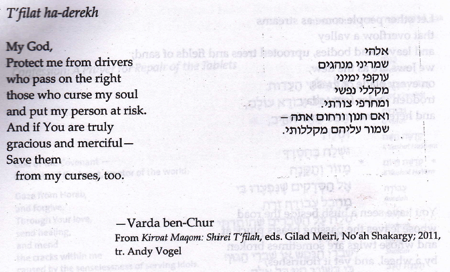
The editors of the new machzor found this poem and tried it out in a test version.  It is a modern prayer entitled T’filat Ha-derech which is also the name of the very old and traditional prayer for the traveler, for someone on the road.  It’s by Varda ben-Chur.

Let’s investigate this poem.  The start could not be more traditional:  elohai.  My God.  How many times do we look to God and begin meekly, “My God, please hear me.”  And how many times do we have no actual prayerful interaction in mind but just yell out, exasperated “My God!”  We could begin this poem in this way, “My God!  Save me from these drivers!”  It is a plea, a gasp, an exhortation to no one in particular when we get frustrated.  We say, “Lord, these people are getting on my nerves” and we find ourselves needing language that will lead us to a higher power because, lordy, lordy, lordy, the powers down here are not saving me from crazy drivers.

My God, protect me from the drivers who pass on the right.  Sometimes we come here and we seek support for the little things.  Sometimes we turn to God not to help us cure cancer, not to help us end war but to help us get through the day when someone passes on the right, when someone throws an unintended insult, when someone does pretty much anything that drives us crazy.  I am just trying to make my way down the road and these road rage crazies curse me?  They curse me?  They put my life at risk!  The nerve!  In the car, with the radio on, moving at a quick clip, there’s little time for reflection.  Something goes wrong, blame the other guy.  

And then there is the finish to the poem when we are not in the car.  The radio is not on.  We are moving at a slow thoughtful pace.  Rosh Hashana is here.  A celebration with family and friends and a chance, a welcome chance if we do it right, to think of our own actions.  We turn to God directly, or we turn to God as a path to our souls and, if we are brave, we get to the heart of it.  My God, today is not about You keeping them from me.  Today is about me and about being honest about me and if You have any grace and mercy, and if I have any honesty at all, you will save them from my curses.

By the end of the poem we know, we know, that if they can be the problem, I can be the problem, too.  If they can be caustic, I can be caustic, too.  And bottom line, I don’t know where those other drivers are but I know where I am.  I am right here.  And I need to take responsibility for myself.  My God, save them from my curses, too.  My God, lead me to understand something about myself.  My God, let me not worry over the literal words of my prayers.  Just let me speak to something, anything, in order to have the dialogue I need to be true to myself.  Let this night and tomorrow morning be the chance, the rare chance I have, to be honest so I can be the best I can be.


Tuesday, May 29, 2012

Confirmation Speeches 2012


Rebecca Levinstein
  Give an example of something in the past that helped you stay Jewish.
Something from the past that has helped me stay Jewish was learning from my parents how important being Jewish is. My Dad grew up in a Jewish home and had his Bar Mitzvah when he was 13. It was in an Orthodox Synagogue, so the men sat down stairs and the women sat upstairs in the balcony. My Mom, on the other hand, had her Bat mitzvah when she was 32. She was raised Protestant and converted to Judaism. She made her Bat Mitzvah when she was 9 months pregnant with my sister, Aliya. According to her, this was not an easy task. Their upbringings taught me how dedicated my parents are to give my sister, brothers, and I a strong, Jewish upbringing.
Give an example of how you will live a Jewish life in the future.
          An example of how I will live a Jewish life is continuing Jewish traditions that I have experienced growing up in my home, from going to Friday night services, to having special holiday dinners.  I hope to one day be making the recipes my mom made, keeping kosher, teaching my children these traditions, and having them pass down the traditions to their children. I will tell them about NFTY and all of the wonderful times they will have and the wonderful friends they will make.

Rebecca Levinstein                                                                        Confirmation Speech
            There are many times in my life that I thought about not coming to religious school anymore because, to be honest, I thought it was a waste of my time. But with a little bit of convincing from my parents, and my sister telling me how much better it will get, I decided to continue coming. And today, looking back, I am so glad that I made the right decision to stay. I have learned so much about Judaism in religious school, from learning about the history of Israel, to learning how important being Jewish is. And if I stopped attending religious school, then I would just be throwing away all the information that I have learned.
I have made so many amazing, new friends in NFTY that I would not trade for the anything in the world. I love going to NFTY events and knowing that I will always have someone to talk to on the bus ride. Between family, friends, NFTY, NewTY, and the Jewish community, I can’t go more than one day without hearing someone say something about the temple, or the youth group which might sound like it’s a bad thing, but it’s really not. I love hearing people from our congregation talking about Torah study and friends in NewTY talk about how excited they are for the next NFTY event.
Everyone from the Jewish community means so much to me and they all hold a special place in my heart. I cannot imagine how my life would be without having Judaism in it.
I would like to thank Cantor Anna for helping me prepare for reading my Torah portion. Thank you to Deborah Freedman for being such a great youth group advisor. Without her, I would not have NewTY and NFTY in my life. Thank you to Rabbi Freedman for believing in me and yelling at me to talk louder in class. But mostly telling Lindsay, Hannah, Adam, and Lev to be quiet so I can answer your questions. Thank you to my class. We started off with about 12 people, but we are the remaining five who have taken Judaism into our hearts forever. We will always have a special bond. Lastly, I want to thank my wonderful family for loving and supporting me in everything I do.

Adam Seidman
Confirmation Speech                                     
          I intend to remain and practice Judaism in the future and for the rest of my life. It has helped me so much already in situations in the past that I cannot just give that up. One example is when my grandfather died.  I did not know what to do.  I didn’t know what was appropriate and what was not or what to say and not to say. Judaism helped me distinguish what was right and wrong. Whether through morals and ethics or just plain “what should I do,” Jewish teachings haven’t steered me wrong. Being Jewish is important to me. It has taught me so much like the origin of my ancestry and how ancient Judaism evolved to modern Judaism.
I intend to keep learning, and utilize the knowledge that Judaism and the Torah has to offer me. I hope my future kids and even their kids will be Jewish and use it just as I have. I intend to do this by passing on everything about Judaism I know to my children and try to inspire them to want to be Jewish just as my Dad did for me.
Both my parents were so encouraging and I wouldn’t have made it this far without them.  I want my kids to be as proud of being Jewish as I am:  proud enough that they will past it on to their kids and so on and so on.

Hanna Gross
For our confirmation speeches, the rabbi gave us six questions and told us to answer three. Being the talkative person that I am, I couldn't choose just three so I did four. Then after revising my answers at least three times, I had to choose just one of my answers to read tonight. I still couldn't choose. So I thought of what I was going to say one night when I couldn't sleep.
I thought... What does Judaism mean to me? Judaism is my life and is a big part of who I am today and every day of my life. Judaism is what defines me and what my life is about. A majority of my decisions and actions are based on my Jewish values. As you all definitely know by now, my father has an extensive knowledge of Jewish history and the land of Israel. That means that every time I'm assigned a project on my choice of area or country to research, I know I've got this one in the bag. Faced with having to create a revolution in Global Studies, I obviously chose to re-create the destruction of the second Temple in chocolate: cake and all.
As I made my chocolate cake Temple presentation in class, we began to chat about the McDonalds in Israel that my family visited. The girl who sits in front of me then turned me and said, “But, like, don't Jews, like *hair flip*, not believe in fast food?" Confronted with this question, which could be depicted as the definition of pure ignorance, I faced it head on, seeing it as an opportunity to educate someone else on our religion, our customs and our culture. I see Judaism as not only a teaching experience, but as a learning experience. Right after my bat mitzvah, my family and I took an 18 day trip to Israel where I experienced the beauty of the land of my ancestors. Going to Israel really helped me to realize and understand the true meanings of our religion and of our history. In the future I plan to raise my children in a Jewish household and to instill in them the same Jewish values that I believe it today. It is so important to me to carry on the traditions of our family. I know that all families have wonderful holiday memories, but I couldn't imagine my life without the traditions we have in our family. Our animated seders every year (by far my favorite one was when we were able to really have lice at our table), our Hanukkah song sessions with the Gross’ when we light enough menorahs to light up the entire neighborhood, and being able to share the simchas of bar and bat mitzvahs with all of our cousins. I feel like Judaism is more than just my religion. It is about my traditions, my heritage, it is my blood and I want to carry it on because I'm proud of it. Lastly, I want to thank my confirmation class. Although there are only half as many people as when we started, back when we were younger, were still just as powerful. There is no other group of people I would have rather taken this journey with.
Do you intend to continue to be Jewish?
It is important for me to continue being Jewish, because my life wouldn’t be the same without it. I wouldn’t be able to live a full life without that part of me. I can’t wait to walk to temple each Tuesday to be with my Jewish friends. I look forward to being there on Sundays so that I can enjoy the laughter of the little kids as they learn about being Jewish. I love that when I do a special Mitzvah I know that I am doing it because I am supposed to and not because I get accolades. But my favorite part of being at temple is knowing that I have an extended family of people who love and care for me and that I know I can trust and depend on. Judaism is interesting, fun and most of all it makes me unique and different from others. 
Give an example of something in the past that helped you stay Jewish.
Right after my Bat Mitzvah my family and I took an 18 day trip to Israel where I experienced the beauty of the land of my ancestors. Going to Israel really helped me realize the great joy of being Jewish and it really helped me to understand the true meanings of our religion and our history. I remember being at the Western Wall and thinking, “Wow, I am really here!” I know that everyone says that they want to go to Israel but until you are actually there you do not even realize the importance of that connection. I know I am a Jew and I am proud of it, but now that I have been to Israel I feel more connected than I ever did. I am proud to be able to tell people that I have been there and about our experiences. Eating lunch in McDonalds in Israel is something fun to talk about but when you tell people that you floated in the Dead Sea or that you watched the sunset in Jaffa they are so intrigued and want to hear more. Lighting candles on Shabbat in Israel is the greatest feeling because you really feel the spirituality of being Jewish and being in Israel especially when you look out the window and see the entire town quiet because you know that everyone is celebrating Shabbat.  

Lindsay Johnson:
Question:  Do you intend to continue to be Jewish?  Why is that important to you?
Yes I do intend to continue to be Jewish after this year. It’s important to me because I want my children, when I have them, to keep the tradition alive because it's a big part of my life and I want it to be a big part of their lives. I have gotten the chance to be part of a youth group and I can not tell you how many friends I’ve made by going on all these trips. I’ve made so many friends through NFTY-GER.
I have to say that all the things that I’ve gone to in to in the past two years have changed me completely in the way I look at things and how I act towards people.  It really makes me think about my future. I want my children to come up to me one day and say thank you and right then and there I’ll know it’s because I made them go to temple.  It has really changed me and I want them to experience what I’ve experienced in the past couple of years with youth group and everyone that I've met and talked to. For me it has been so exciting to go back to each event.
I’m going to have to say John Ross has made one of the biggest impacts in my life.  He’s one of the first people I met at new member kallah last year when I was a freshman and he’s put a smile on my face. When I first met him we had to find a partner to play the game peg.  We had to find a horse or rider and he was the first person I saw so I went straight to him. From then on out he has acted like a big brother to me.
My life would be totally different if I stopped going to temple and religious school because you can learn so much in a few years and make new friends.  I intend to keep moving forward and keep going to temple because of the fact I want to and its a huge part of my life.

Question:  When thinking about my Judaism, how am I different now then when I became Bar Mitzvah?
When I look back and think about it, I was learning a lot more back then although we didn’t really learn about our history as much as we learned our Hebrew and Torah portions. But after that 8th grade 9th grade we learned about how much effort and power and strength we had as a whole to fight for our rights.
Did you know that on May 14, 1948 Israel gained independence and became a nation and was recognized by the United Nations? Yeah, crazy, I know. Well its one thing to hear about it but, it’s another to learn the history behind it, how much we had fought to create Israel and still keep our identity as a Jews.  How amazing is that?

Question:  Give an example of something in the past that helped you stay Jewish.
Something that’s really helped me stay Jewish in the past is my family. They are very Jewish.  They celebrate all of the Jewish holidays. I know that on the holidays we always go over to my aunt Aileen’s and Uncle David’s for dinner. We do the services there and we always have a great time. The women cook while the men set the table.  It’s like a family reunion and they’re a big part in my life. They have also always been there for me when I need them and the fact that they’re Jewish and religious keeps it going in my whole family. My family is a big part of me.  We all live in the same state except my grandparents and I call them usually when ever I need something. Because, as my family always says, “I’m always just a phone call away.”  I don’t know what I’d do with out them because they have been there for me since day one.

Lev Freedman
Question:  Do you intend to continue to be Jewish?  Why is that important to you?

Throughout my relatively short life, I have been raised on Judaism.  People always ask me what it’s like being the rabbi’s son.  Kids at school immediately assume that I’m an ultra-orthodox Chasid and so do the ultra-orthodox Chasids.  So it makes me wonder if I was “meant” to be Jewish, but that’s not why I will continue my Judaism.  No.  I intend to continue to be Jewish for a number of reasons.  Judaism has always been a huge part of my family ever since Temple Sinai in Pittsburgh.  At every temple we have been to, we have found friends and wonderful people to associate with.  In this way, Judaism has provided a second home, a place to have fun or be serious, a place to sing, to dance, to go to bar mitzvahs, great times, great stories, and something to believe in.  Judaism has let me be a part of something bigger than myself, bigger than my school; in company over 15 million strong, and yet still so unique.  Judaism has let me be different, stand out, even if I get asked if I “speak Jewish” about twice a day. 
            Being Jewish has also led to the greatest times of my life.  Places like Crane Lake Camp and NFTY have allowed me to have fun and be myself, and make lifelong friends.  These are things I want my children and grandchildren to experience, so that they can have the time of their lives, be unique, and be a part of something special. 
            So, I will be marrying a nice Jewish girl because carrying on this religion and these traditions to the next generation is important to me.  And maybe it was just luck that being Jewish led to meet so many awesome people but I don’t think so.  Without Judaism, I wouldn’t be who I am today. 

Question:  Give an example of something in the past that helped you stay Jewish. 
After my “SpongeBob: The Movie” soundtrack would end, I would slip in a Dan Nichols CD as I prepared for bed.  The 8-year-old me may not have known exactly what Mr. Nichols was saying, but he knew that he loved it.  He knew it was Judaism and its message was symbolic of its ways.  The 8-year-old me heard this kind of music as a modern, clear, and understandable form of Judaism; something he could love and feel.  And as the 8-year-old grew into who he is today, he saw the music follow him.  It followed me to NFTY and temple and camp and life and it let me be crazy and fun and me.  It let me connect with the people around me and sing louder than ever.  So music helped me stay Jewish because it showed me that Judaism is fun and loving and hateless. 
The Reform movement is convenient: it fits into my life and is there when I need it.  And without music, I would not be so inspired by what Judaism can do for me and what it has done. 

Question: Growing up Jewish in my school how did I keep my identity?    
Fourth grade brought a lot of new experiences for me.  I began to believe that high socks were too nerdy, among other things, and started to become a different person.  When my family and I moved to Newton, I began listening to rap, sagging my pants and I really only cared about being cool.  When my fellow 5th graders at Angier Elementary would ask me if I was Jewish, I would respond with a hesitant “no”.  You could blame it on immaturity but my reluctance to be different, to show who I really was, was a terrible thing.  Being Jewish was different and the different kids were weird.  With time I’ve learned to embrace Judaism as something that is as much a part of me as my own skin.  However, the choices I made, which often included abandoning my true friends for the cool kids, (oddly similar to the musical “13”), were each individual stops to a loss of identity.  Thanks to camp, NFTY, and my older brother, I was shown that being different is okay, and being myself is valuable.  

Friday, April 27, 2012

Day 19

Still counting the omer.  Today is day  19 as we draw near to Sinai and Shavuot.

Here's  another anonymous writer answering, What does Israel mean to me?

Israel means "home."  It is living with your extremely large extended family.  It is never having to  "define" your food (latke, knish, charoset, sufganiyot).  It is being able to keep a kosher home with driving one hour to buy mean.  It is never having to deal with your crying child when someone tells him thatJews are cheap.  It is not having to explain that Christmas is not a secularl holiday.  It is our assurance that there is a place that will never persecute you for being a Jew.


Wednesday, April 25, 2012

Day 18

On the 18th day of counting the Omer we have two anonymous  writers

Israel: A lifetime wih to visit and walk the paths of our Lord.

My heritage.  I am proud to be a Jew.  I love all our holidays and everyday life as being a Jew.  I try my best to be a good one.

Sunday, April 22, 2012

Day 16

Day 16 of counting the omer.

Here's today's answer from Mike Menichiello.

For me it has always symbolized strength.  I remember being a child when a plane was hijacked and how amazed I was with how Israel handled the situation.  The message that I remember was swift and powerful: a message of solidarity, power and unity.

Saturday, April 21, 2012

Day 15

Sherrill Lazarus wrote a poem for Day 15 of counting the omer.

Independence - Freedom to be a Jew, however we define that word - ISRAEL
Shalom - Where everyone shares responsibility to care for one another - ISRAEL
Religion - At the center, ha makom, we have our religion - ISRAEL
Acceptance - Though we are from many places and many paths, here we are all one - ISRAEL
Eretz Israel - our place, our piece of this Earth, now and forever ours - ISRAEL
Life - The Jewish heart and soul and center and spirit - ISRAEL